
Hey, Brass Fans!
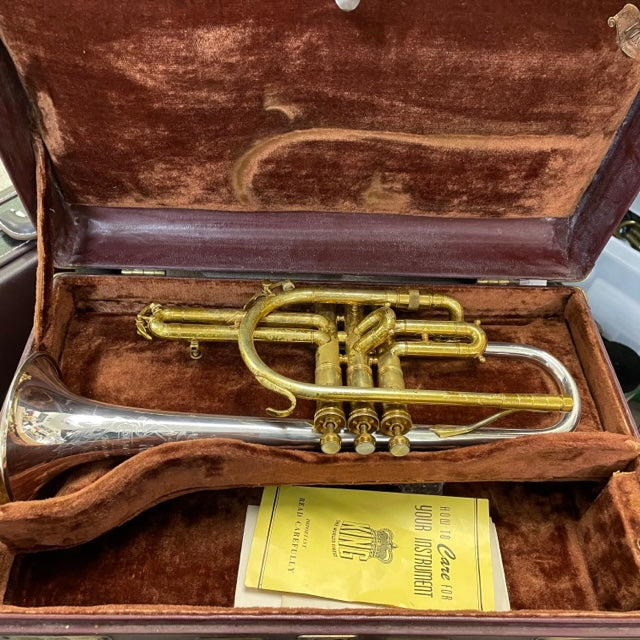
Here’s a look into the process our used and vintage brass instruments go through from arrival to listing with this 1948 King SilverTone Master Model Cornet.
1. The boss bought this one at an auction, and on arrival it is tagged and entered into our system by the lovely Suzanne.

2. Then she leaves it in the receiving area for me, and I assess condition and look for any damage. I check the contents of the case, and make sure that everything factory for the instrument stays, and remove any garbage. This cornet came with original care and warranty sheets, which will stay with the instrument.


3. Next, I disassemble this little guy for cleaning! I take apart the water keys and all parts of valves as everything is quite dirty from being put away for a lot of years. All felt, cork, and water key springs are due for replacement. It’s now ready for a wash in soapy water and a soak in the tank. No ultrasonics for this one, since we don’t want to do any damage! Based on age and condition, I usually assess whether to turn the UC on. In this case we don’t want to remove any existing lacquer, as there is not much left. While it soaks, I clean up the small parts and get corks installed.


4. After a soak for the chemical to help loosen up all the calcification and old yuck inside, we flush to brush it all out. This one is much cleaner now! Then another good wash to make sure all grit is removed from the flush.

5. Finally, clean and with a nicely polished bell, it’s time to reassemble! I measure for correct thickness of valve felt and cork, and check to make sure ports align with tubing.


6. Now the best part - the play test! This one plays very well - not a big surprise since I own one of these myself! Beautiful, ready to photograph, list, and find it’s new home.


Hope you’ve enjoyed this process as much as I do!
Amanda
Share:
Kim Fullerton Plays the Selmer Paris Model 41 Contrabass Clarinet
What's on My Bench? A Silver Bach Stradivarius Trombone with an Infinity Valve
5 comments
Great article! Do you buy vintage used instruments? I have a Getzen cornet from the 1950’s. Good condition. I’m the original owner. Thank you ! Carol Bell
Still got it or similar older Brass.
How much? Ty 🎺
For John Verdugo!
Here’s a link to listen to the King cornet!
https://youtu.be/IEKvjNoN2Tk
Amanda – you’re so cool! Miss you! – Josh
I really appreciate the article and the care taken to give life to a lovely old work of art.
I’d love to hear what it sounds like!
Is there any way it might be possible?
I am a coronet player, since 1964.
Also played French horn, baritone, and trumpet as well.
So as you might see, I am serious about hearing this horn.
Let me know? Thank you again for sharing the effort and process in restoring this jewel!
J.V.