call
call

World War II saw the mobilization of money, people, resources and more for the production of equipment used during the conflict. The Allies outpaced the Axis powers in almost all production categories. So I guess we should not be surprised that a musical instrument company like C. G. Conn Ltd. would divert their product line from saxophones and trumpets to tools useful in a war scenario.

During the war period from 1942 to 1945, Conn ceased all production of musical instruments for civilian use to manufacture brass components for compasses, altimeters, and other military instrumentation. (Wikipedia)


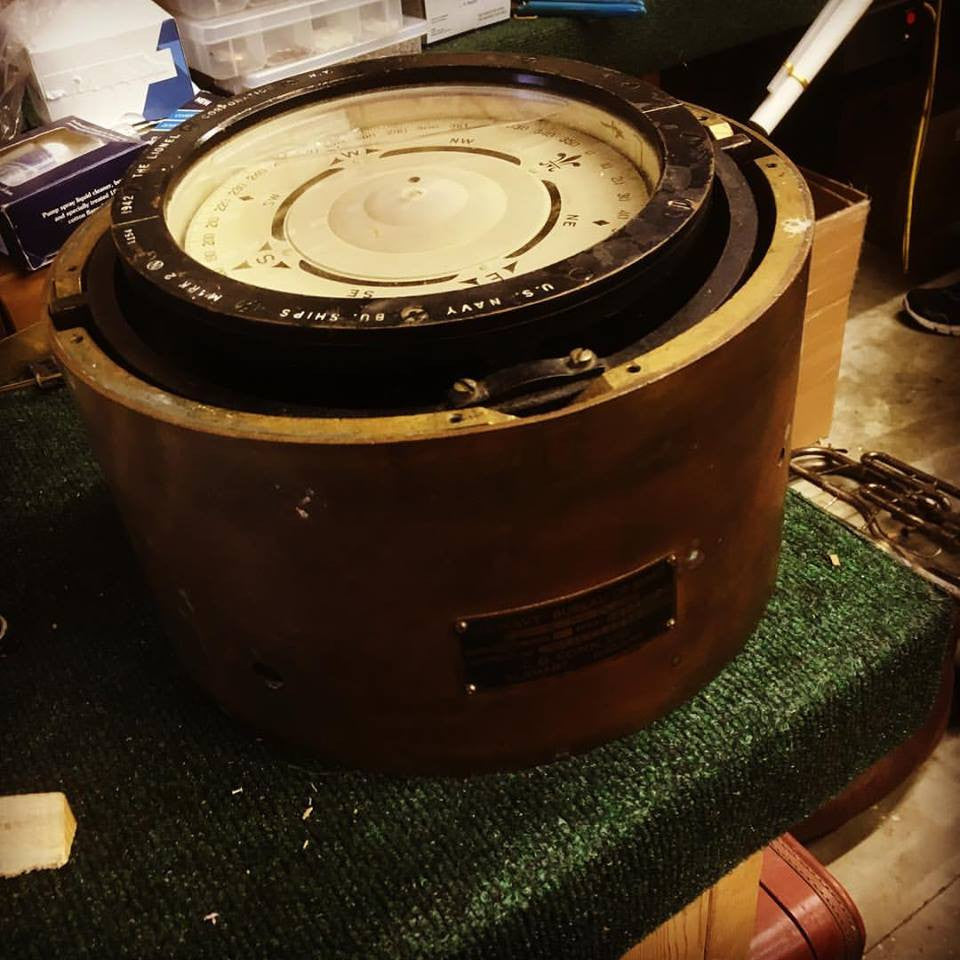
That's why this particular ship compass, made by Conn and discovered in one of our travels through antique hordes is rather interesting. A compass is an instrument used for navigation and orientation that shows direction relative to the geographic "cardinal directions", or "points". Usually, a diagram called a compass rose, shows the directions north, south, east, and west on the compass face as abbreviated initials.


When the compass is used, the rose can be aligned with the corresponding geographic directions, so, for example, the "N" mark on the rose really points to the north. Frequently, in addition to the rose or sometimes instead of it, angle markings in degrees are shown on the compass. North corresponds to zero degrees, and the angles increase clockwise, so east is 90 degrees, south is 180, and west is 270. These numbers allow the compass to show azimuths or bearings, which are commonly stated in this notation.


This particular one is made of brass and has some lovely but functional details. It now sits in the maintenance and shipping room of the The Mighty Quinn Brass and Winds shop.
Latest Stories

View all

How to Choose a Professional Saxophone: Yamaha vs. Yanagisawa vs. Selmer vs. Eastman

How to Choose a Professional Saxophone: Yamaha vs. Yanagisawa vs. Selmer vs. Eastman

Choosing a professional saxophone is less about finding the “best” horn overall and more about finding the one that perfectly fits your sound, playing style, and long-term goals. Yamaha, Yanagisawa, Selmer Paris, and Eastman all produce stage-ready professional instruments, but they approach ergonomics, aesthetics, and tonal philosophy differently. This comprehensive guide breaks down the major contemporary lines from each legendary manufacturer to help you identify the perfect match for your musical voice.

Read more

Choosing Your Instrument: Student, Step-Up, and Professional Tiers

Choosing Your Instrument: Student, Step-Up, and Professional Tiers

Selecting the right brass or woodwind instrument is a pivotal moment in any musician’s journey. From the durability required by beginners to the nuanced craftsmanship sought by professionals, the differences between instrument tiers are rooted in a century of design evolution. This guide explores the distinct characteristics of student, step-up, and professional models to help you make an informed investment that supports your specific musical goals and growth.

Read more

Shires Q38 and Q39 Contrabass Trombones: European vs. American Tuning

Shires Q38 and Q39 Contrabass Trombones: European vs. American Tuning

We are thrilled to welcome the Shires Q38 and Q39 contrabass trombones to the shop, offering players a serious and professional entry into the world of true low brass authority. These models acknowledge the diverse traditions of contrabass playing by offering two distinct tuning systems: the Q38 in European tuning (F/D/BBb/AAb) and the Q39 in American tuning (F/Db/C/AA). With additional options for gold or yellow brass bells, these instruments provide the depth and presence required for the most demanding orchestral and film repertoire.

Read more