
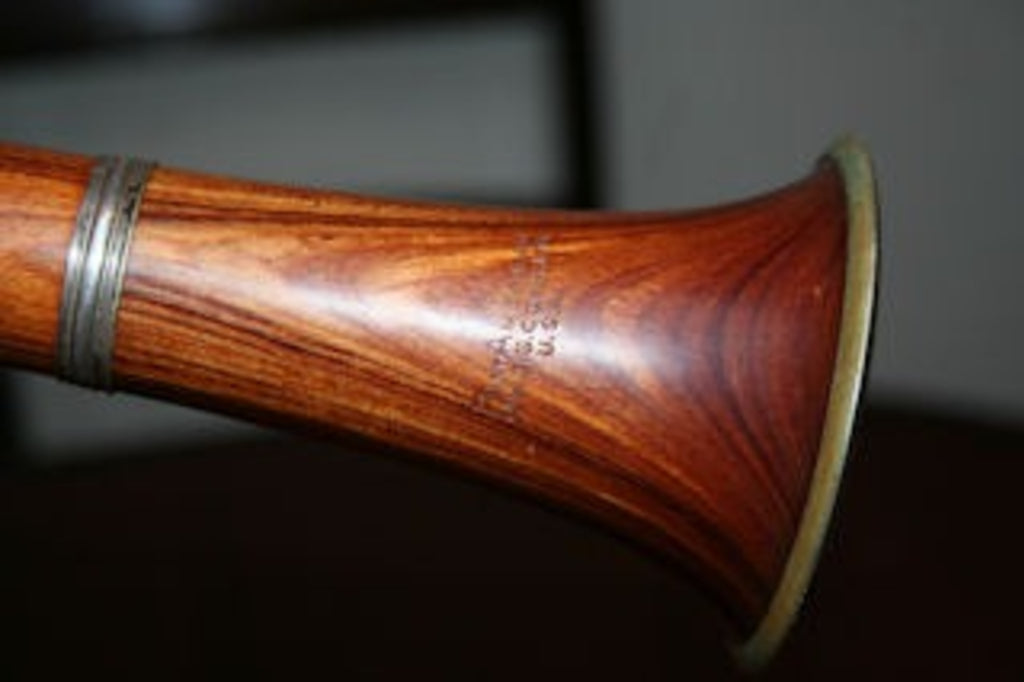
We came across this striking Pan American “Violin Finish” clarinet (made by Conn) mistakenly described on eBay as made from pear wood. It is in fact commonly known as a propeller wood clarinet. This particular instrument was dirt cheap and at this point unplayable without an overhaul.
This instrument was an ingenious solution by Conn to the scarcity of Grenadilla wood during the Second World War. Unsubstantiated sources say the same wood was used in the manufacture of WWII B24 Liberator Bomber Propellers’, hence the nick name; “Propeller wood clarinet”. That has since been debunked. They came in plastic or Cocobolo plywood.

Bill Hausmann says this about the instrument in the Klarinet Archive:
“I believe, Conn began manufacturing clarinets out of laminated wood (essentially thick plywood, similar to what is used to manufacture wooden aircraft propellers) to be sold under their cheaper Pan-American brand. The main idea was to create a clarinet which would not crack. When the laminated billets were turned on the lathes to produce clarinet bodies, a very beautiful false grain pattern was revealed. Since the laminated wood did not take stain well, the clarinets were left unstained and this, coupled with the very bold and symmetrical grain pattern, made these strikingly beautiful instruments.
While they do resist cracking very well, a bad batch of wood caused some of these clarinets to de-laminate, which ruined their reputation and production ended after just a few years. Officially called “violin finish,” these clarinets are not particularly good players, but are in high demand on eBay, etc., just for their looks.
I think the tone hole inserts were pretty much necessary on these models because the laminated wood would likely chip apart if they attempted to do the fine cutting necessary to make integral tone holes.”
This instrument is indeed a student quality instrument. The original mouthpiece was done in white acrylic.
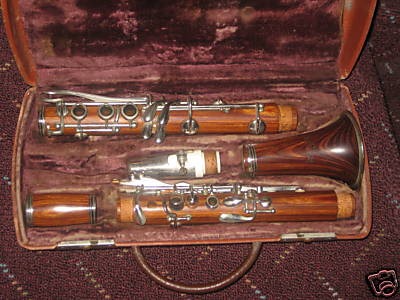
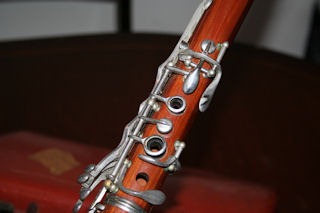
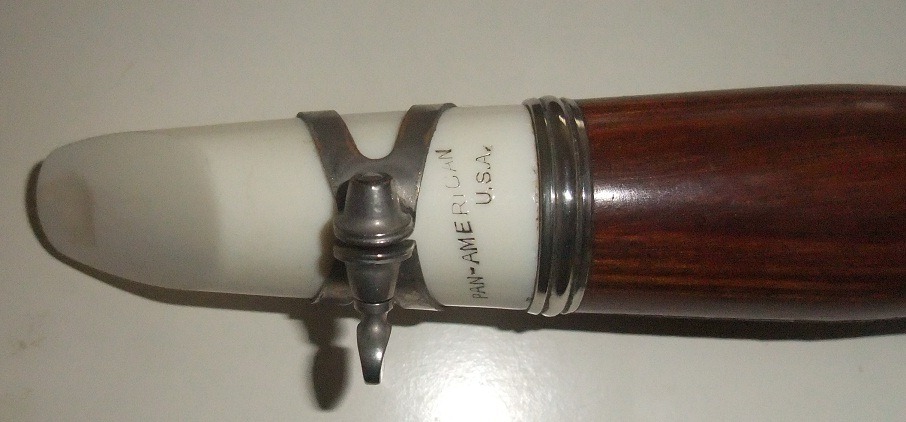
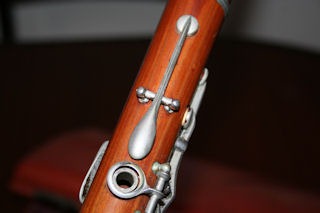
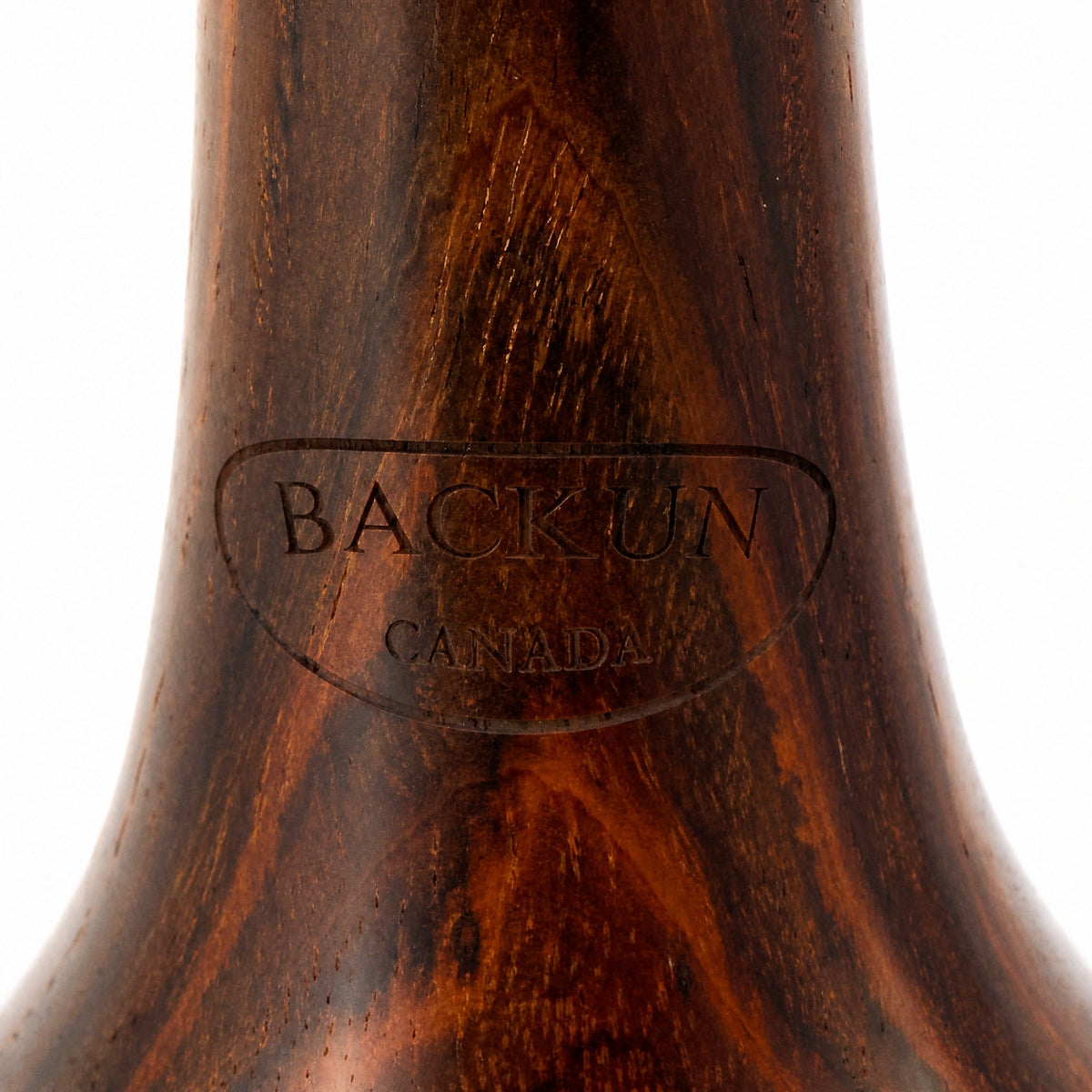
The Pan American “Violin Finish” Clarinet according to the brochures, flyers and price lists was a light-colored violin finish for wood clarinets. They first popped up in the Spring of 1950 and the last mention of it was in January 18, 1954. The National Music Museum in South Dakota list these references for the clarinet model:
- Pan American “The Baton” Newsletter in Spring 1950 lists the “Violin Finish” Clarinet Model 68N for $120.00.
- It was listed as a new item in the C. G. Conn, Ltd. Annual Report to Stockholders for the year ending April 30, 1950.
- It was mentioned in the December 1951, June 8, 1953 and January 18, 1954 Conn price lists.
Share:
Keilwerth Toneking 3000 Jazzophone
Giving Life to the Triebert Brevete “Systeme Dupaquier” C Melody
4 comments
To Kevin McKnight. What a wonderful clarinet knowledge you possess!!
Perhaps you’re a collector—have you a nice wood clarinet to sell? Thanks.
I have a 68N CONN PAN AMERICAN “PROPELLER” VIOLIN WOOD CLARINET my dad bought new in 1951 when I was born. It is in prison condition with everything original including the registration card. I am selling it for $800 on Craigslist.
What is the current estimated worth of this type of clarinet?
You should add that the WWII connection is part of the unsubstantiated claims about this clarinet. The 68N clarinet, along with the 68N Oboe, was launched in 1950 and ended in 1954. Any war time connection is more likely Korean War. my registry of Pan American band instruments confirms this.
During WWII all of Conn’s factories, including Pan American, converted to war production. The US government curtailed all civilian band instrument production from mid 1945 until late/mid 1945. Occasionally production was allowed for the military. Thus a Grenadilla shortage would have no effect. Before the 1942 curtailment Conn advertised pictures of their extensive Grenadilla wood inventory.
During the Korean War, the Conn factory converted to war production again, but the Pan American factory did not.
While Conn relaunched in late 1945, Pan American did not relaunch until 1948. This is after WWII shortages were pretty much eliminated.
In 1948 Pan American launched a Grenadilla model 70N clarinet along with the Director 58N ebonite model. The 68N Cocobolo wood model was an upgrade to the 58N.
Let me know, if you need more information.