
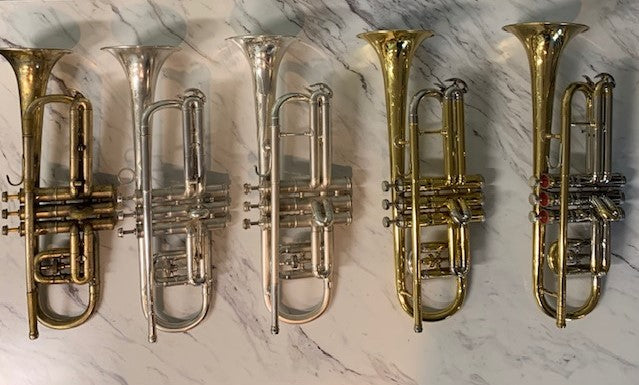
Look out, brass friends! I have some fun posts coming to you! The boss and I have decided to feature some great things from our personal collections. These horns might not be super rare, but it is cool to see so many at once!
I actually took these photos a few months ago when working on a 1956 80A Victor that we sold a while ago. I realized that its year of production fell between the four I have in my own collection, so I had to photograph them together! The years of production shown here are 1920, 1921, 1941, 1956, and 1967. All but the 1957 are part of my personal collection, and all are playable except the 1920.

It’s super interesting to see what features change over time, even though the basic design of the instrument remains the same. The 1920 and 1921 were both built with the mechanism for automatic tuning to A from Bb, and the 1921 still has a working mechanism. It wasn’t working or put together properly when I got it, so it was quite entertaining figuring that one out! When the main tuning slide is pulled to the length for the key of A, the mechanism moves the rest of the instrument’s slides out as well for the key change. While this mechanism may have made tuning on the fly a bit easier, it does NOT make cleaning or disassembly easy, which is probably why so many of these mechanisms are missing.


The 1940's shows the demise of A tuning, as well as changes in engraving patterns and bottom sprung pistons. These horns are very similar to the 50's models, with very few changes made.


The 1960's brought major changes in design to this model, including buttons, caps, engraving, and a change in mouthpiece shank from short shank to long shank.

These all play a bit differently but do have one thing in common - depending on mouthpiece cup shape, they can sound like anything from trumpet to cornet to flugel, and are so lively to play in a Jazz combo setting! The 80A is a little an amusing horn to collect and play. Since they are fairly plentiful, they are not expensive to collect, and may even be rather addictive!


I have a few extra rare horns planned for future posts, so stay tuned!
Wishing you some fun history in your day!
Amanda
Share:
What's on Brad's Bench? A 1957 Selmer Paris Clarinet
What’s on My Bench? A Yamaha YCB-621 C Tuba