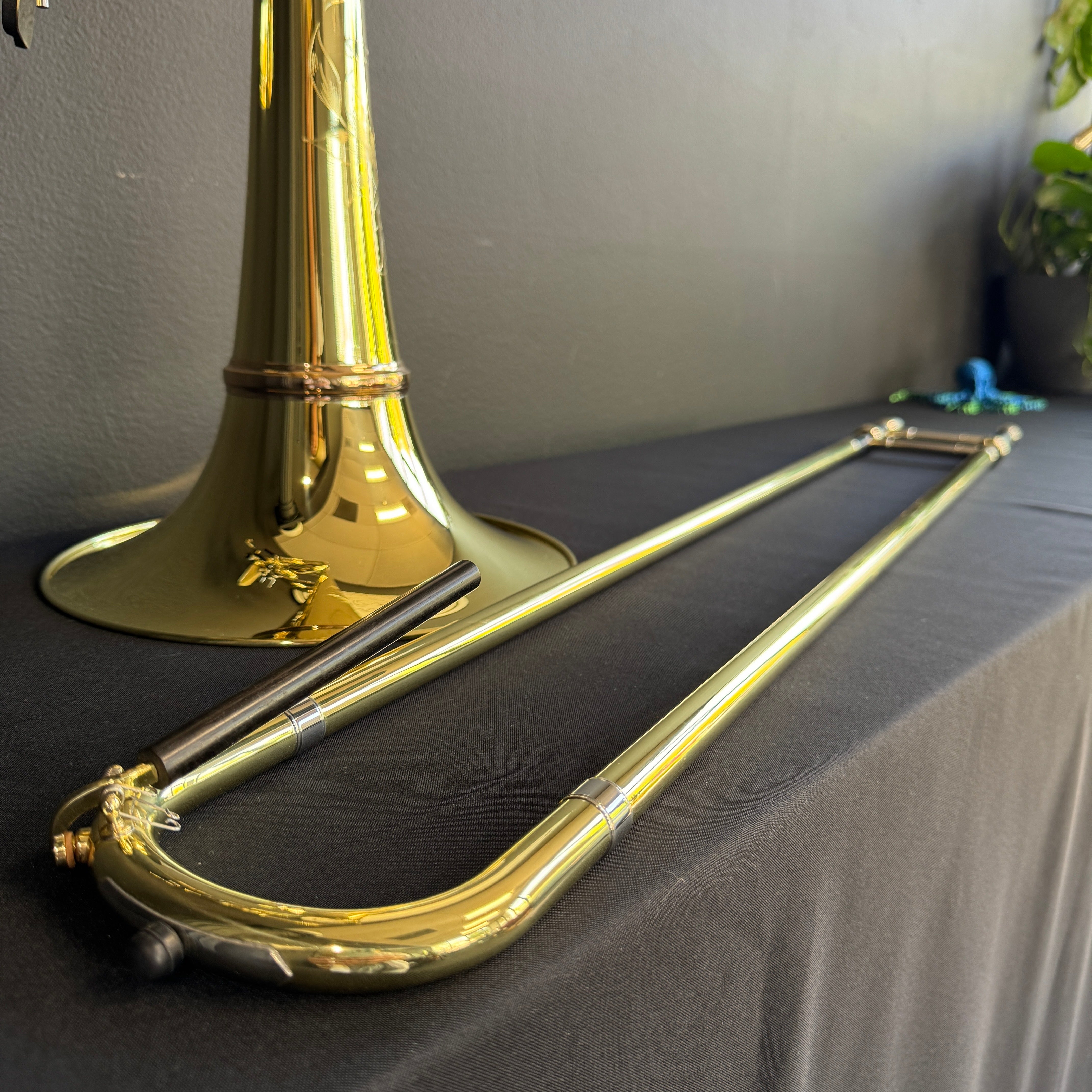
We are pleased to welcome two remarkable new instruments to the shop: the Shires Q38 and Shires Q39 contrabass trombones. For players who have been waiting for a serious contrabass option from a respected maker, these models are well worth a close look. They bring the depth, authority, and unmistakable presence of the contrabass trombone into instruments designed for practical professional use, with thoughtful options that let players choose the setup that best suits their musical world.
What makes these instruments especially interesting is that they offer two distinct tuning approaches. The Q38 is built in European tuning: F/D/BBb/AAb. The Q39 follows American tuning: F/Db/C/AA. That difference is not a small technical footnote. It shapes how the instrument feels under the hands, how it responds in familiar repertoire, and which traditions of playing it naturally supports. For many players, that means the choice between the Q38 and Q39 is not simply about preference, but about matching the instrument to the musical demands they face every week.
Two Contrabass Trombones, Two Approaches
The Shires Q38 will appeal immediately to players who prefer the logic and response of the European F/D/BBb/AAb system. For musicians working in orchestral settings where that approach is standard or simply feels more natural, the Q38 offers a familiar foundation. It is a compelling option for players who want the breadth and gravity of a contrabass trombone without giving up the sense of order and fluency that comes from a tuning system they already know well.
The Shires Q39, by contrast, is designed for players who want the American F/Db/C/AA setup. That makes it especially attractive for low brass musicians trained in the American tradition, as well as doublers and bass trombonists moving into contrabass work who want an instrument that aligns with the tuning logic they are most likely to encounter in that repertoire and playing culture. It is a practical, intelligent design choice, and one that makes the Q39 immediately relevant for many working players.
The Rotax Valve Advantage
What truly bridges the gap between the European and American tuning systems on these models is the inclusion of Rotax valves. These valves are a critical component of the Q Series design, offering a specific set of performance characteristics:
-
Geometry: Rotax valves feature a unique, often flatter, internal rotor geometry that transitions into an expanding shape, which reduces air turbulence as it directs air back into the instrument.
-
Feel & Sound: These valves are known to be light and fast, providing a "solid core" in the low register that many players find essential for contrabass work.
-
Centered Response: They are often described as having a very smooth, quick action that feels more secure and centered than an axial-flow valve.
-
Modern Application: Rotax valves are used to provide the benefits of a modern free-blowing valve while retaining the quicker response and feedback of a more traditional rotary valve.

Bell Options: Gold Brass or Yellow Brass
Both the Q38 and Q39 are available with either a gold brass bell or a yellow brass bell, which gives players another meaningful way to tailor the instrument to their needs.
A gold brass bell will often appeal to players looking for a warmer, broader, and slightly more complex sound profile. In a large orchestra, that can translate into a tone with real weight and color, especially in passages where the contrabass trombone must underpin the entire brass section without becoming blunt or overbearing.
A yellow brass bell may attract players who want a more direct, lively response and a sound with a bit more immediacy. In situations where clarity, projection, and definition matter most, that can be a very attractive choice. Some players will simply know which bell material suits their concept of sound; others will enjoy having two clearly useful paths rather than a one-size-fits-all setup.
Why These Models Stand Out
Contrabass trombones occupy a specialized place in the low brass world. They are not everyday instruments for every player, but when the music calls for one, nothing else quite does the same job. That is part of what makes the Shires Q38 and Q39 so noteworthy. They are purpose-built instruments for musicians who need true contrabass depth, but they are also designed with enough practical thought to make them approachable for players entering this part of the repertoire more seriously.
What sets these models apart is not merely that they exist, but that they acknowledge the real diversity of contrabass playing practice. Some makers offer a single concept and expect the player to adapt. Here, Shires has recognized that tuning systems matter, that bell material matters, and that players come to the contrabass trombone from different traditions. The result is a pair of instruments that feel more specific, more usable, and more respectful of the player’s actual musical life.
Who Will Be Interested?
These instruments will be of particular interest to professional orchestral players, freelancers, serious conservatory students, and bass trombonists expanding into contrabass work. They also make sense for institutions and studios looking to add a capable, versatile contrabass trombone for advanced ensemble playing.
If you regularly encounter repertoire by Wagner, Strauss, Schoenberg, or modern film and symphonic composers, a dedicated contrabass trombone can change the experience completely. The right instrument does more than produce lower notes. It gives the section a different foundation, a different color, and a different sense of scale. For the player, that means less compromise and more confidence when the part truly needs contrabass character rather than an approximation.
How Players Might Use Them
Consider the orchestral freelancer who is called for a large late-Romantic program and needs an instrument that can supply true depth without feeling unfamiliar in a high-pressure rehearsal cycle. A player comfortable with European tuning may find the Q38 the natural choice, allowing them to focus on phrasing, blend, and timing rather than adapting to a different valve layout.
Or think of the bass trombonist stepping into a film session where the writing demands immense low brass weight and a sound that can anchor the entire ensemble. For that player, the Q39 may feel immediately practical, especially if the American tuning system matches their training and instincts. In that setting, familiarity is not a luxury. It is part of doing the job well.
A conservatory student preparing excerpts and learning the distinct role of the contrabass trombone may also find these models especially appealing. Instead of treating the instrument as an occasional novelty, they can work with a serious setup that reflects real professional standards. That matters in the practice room, where consistency and confidence shape progress long before any audition or performance.
Even for players choosing between bell materials, the real-world benefits are easy to imagine. A musician seeking a broader, darker orchestral cushion may gravitate toward gold brass. Another who wants a more immediate front to the sound for clear articulation in large ensemble textures may prefer yellow brass. These are useful choices, not decorative ones.
A Thoughtful Addition to the Low Brass Landscape
The Shires Q38 and Q39 contrabass trombones are exciting additions because they take a specialized instrument seriously. They do not reduce the contrabass trombone to a curiosity or a niche accessory. Instead, they present it as a practical, musically consequential tool for players who need real low brass authority and want options that reflect how they actually perform.
Whether you are drawn to the Q38 in European tuning (F/D/BBb/AAb) or the Q39 in American tuning (F/Db/C/AA), and whether your sound concept points you toward a gold brass bell or a yellow brass bell, these new Shires models offer a compelling way to explore what a modern contrabass trombone can be.
If you have been curious about adding a contrabass trombone to your setup, or if you have been waiting for an instrument that better matches your training and playing needs, the Shires Q38 and Q39 deserve your attention.
Explore our collection of Shires Trombones here.
Share:
The Eastman CC Tuba Guide: Finding Your Sound in the EBC Series
Choosing Your Instrument: Student, Step-Up, and Professional Tiers