

Adolphe Sax is remembered, quite naturally, for the instrument that carries his name. The saxophone was his great calling card, and it has been so successful for so long that it can obscure the rest of his work. But Sax was never only the inventor of one famous instrument. He was a restless, highly practical reformer of musical design: a maker who looked at the instruments of his day, saw their weaknesses, and set about improving them. In that sense, his story belongs not just to the history of brass or woodwinds, but to the wider nineteenth-century effort to rebuild the orchestra and military band for a new age of public performance, industrial craftsmanship, and expanding musical ambition.
That story begins in the Low Countries. Antoine-Joseph “Adolphe” Sax was born in Dinant, in present-day Belgium, in 1814, into a family of instrument makers. His father, Charles-Joseph Sax, built wind instruments, and the young Adolphe grew up in a workshop environment where acoustics, metalwork, woodturning, and repair were not abstractions but daily realities. He studied in Brussels, gained attention early for his technical skill, and by the 1840s had moved to Paris, which was then the decisive center for instrument making, musical fashion, and military-band reform.
Paris was the right place for a man like Sax. The city rewarded invention, but it also demanded results. Instrument makers were competing not merely on elegance, but on projection, intonation, mechanical reliability, and usefulness in large ensembles. Concert life was changing. Military bands were growing in prestige and visibility. Composers and conductors wanted instruments that could carry outdoors, blend indoors, and do so with more consistency than many earlier designs allowed. Sax entered this world with unusual confidence and, by all accounts, unusual stamina. He patented families of instruments, fought rivals in court, cultivated powerful supporters, and never lost sight of the basic question: could an instrument be made more effective for musicians?
That question helps explain why Sax’s work matters far beyond the saxophone. He developed and refined entire instrumental families, especially brasswind designs that sought greater uniformity of tone and better technical facility. His saxhorns were central to the modernization of brass bands. His experiments in bore design, keywork, and instrument families reflected a larger nineteenth-century belief that musical tools could be improved systematically. This was not invention for novelty’s sake. It was invention in the service of sound, ensemble balance, and practical music-making.
Among the instruments caught up in this period of change was the ophicleide. Today the ophicleide occupies a curious place in musical memory. It is known to specialists, collectors, and historically informed performers, but to many listeners it remains a half-familiar name from the early Romantic orchestra: the keyed brass bass that helped bridge the gap between the serpent and the valved tuba. Invented in the early nineteenth century, and usually associated with Jean Hilaire Asté, known as Halary, the ophicleide emerged in France around 1817. Its name, derived from Greek roots meaning something like “serpent key,” acknowledged both its ancestry and its mechanism. It was, in essence, a conical brass instrument with tone holes and keys, designed to provide a more powerful and disciplined bass voice than the older serpent.
For several decades the ophicleide mattered a great deal. It appeared in military bands, opera orchestras, church music, and concert works. Composers such as Berlioz wrote for it with real seriousness. It could be agile, vocal, and surprisingly expressive in capable hands, though it also had its difficulties. Like many keyed brass instruments, it demanded a player who could manage the compromises built into the system. Tone and intonation could vary from note to note. Fingerings required skill and judgment. As valved brass instruments improved, the ophicleide increasingly looked like a brilliant but transitional solution.
This was precisely the sort of transitional moment that attracted Sax. He was not content to inherit instrument types unchanged. He rethought them. In the middle decades of the nineteenth century, when old systems and new ones overlapped uneasily, Sax explored how even established instruments might be remade for modern use. His ophicleides belong to that chapter of his work: less famous than the saxophone, certainly, but entirely in keeping with his larger mission.
What makes Sax’s small ophicleides especially fascinating is that they show him engaging with an instrument already under pressure from history. By the time he was active in Paris, the ophicleide was still important, but it was no longer secure. Valves were changing brass playing. Instrument makers were racing to create families that were more even in tone, more mechanically consistent, and easier to integrate into modern ensembles. Sax did not simply abandon the keyed brass tradition. Instead, he examined what could still be done with it.
His soprano and alto ophicleides are among the most intriguing results of that effort. These are rare instruments, and rare not in the casual sense that one sees on auction listings, but in the stricter historical sense: few were made, fewer survived, and fewer still are known and documented. Their rarity tells us something important. They were not standard commercial products on the scale of Sax’s more successful brass families. They belong to the workshop bench as much as the parade ground: instruments that reveal experimentation, adaptation, and the search for a musical niche.
The soprano ophicleide, by its very nature, occupies unusual territory. The ophicleide is generally imagined as a bass instrument, with all the civic gravity and orchestral heft that implies. A soprano version turns that expectation inside out. Suddenly the keyed brass voice is asked to move higher, brighter, and with a different kind of agility. It becomes less a foundation and more a distinct color. One can imagine why such an instrument might appeal in a period fascinated by timbral variety, military-band brilliance, and the possibility of constructing complete instrumental families across registers.
The alto ophicleide sits in a somewhat more comprehensible middle ground, though it is no less interesting for that. Alto instruments often reveal what makers thought an ensemble was missing. They can serve as bridges: between bass and treble, between solo and supporting roles, between one instrumental family and another. In the case of Sax’s alto ophicleides, one sees his instinct for continuity across ranges. He was always attentive to the problem of how instruments relate to one another, not just how they function individually. A family of instruments, in his view, ought to make musical and acoustical sense as a whole.
For modern musicians, this is where the story becomes more than antiquarian curiosity. Sax’s soprano and alto ophicleides are not merely odd survivors from a dead-end branch of instrument making. They are evidence of a period when the categories we now take for granted were still unsettled. The clean divisions between brass and woodwind technique, between keyed and valved systems, between “successful” inventions and “obsolete” ones, were not so clean at the time. Makers like Sax worked in that uncertainty. They tested possibilities that later history narrowed down. To study these instruments now is to recover some of that lost openness in musical design.
There is also a more human lesson in their existence. Instrument history is often told as a parade of winners. The piano replaces the harpsichord. The valved brass instrument replaces the ophicleide. The saxophone triumphs where other experiments fade. But workshops do not experience history that way. Makers build for present needs, present clients, and present hopes. Some inventions endure because they solve a problem so well that the future keeps them. Others remain as eloquent side paths. Sax’s small ophicleides belong to that second category, and they are all the more compelling because of it.
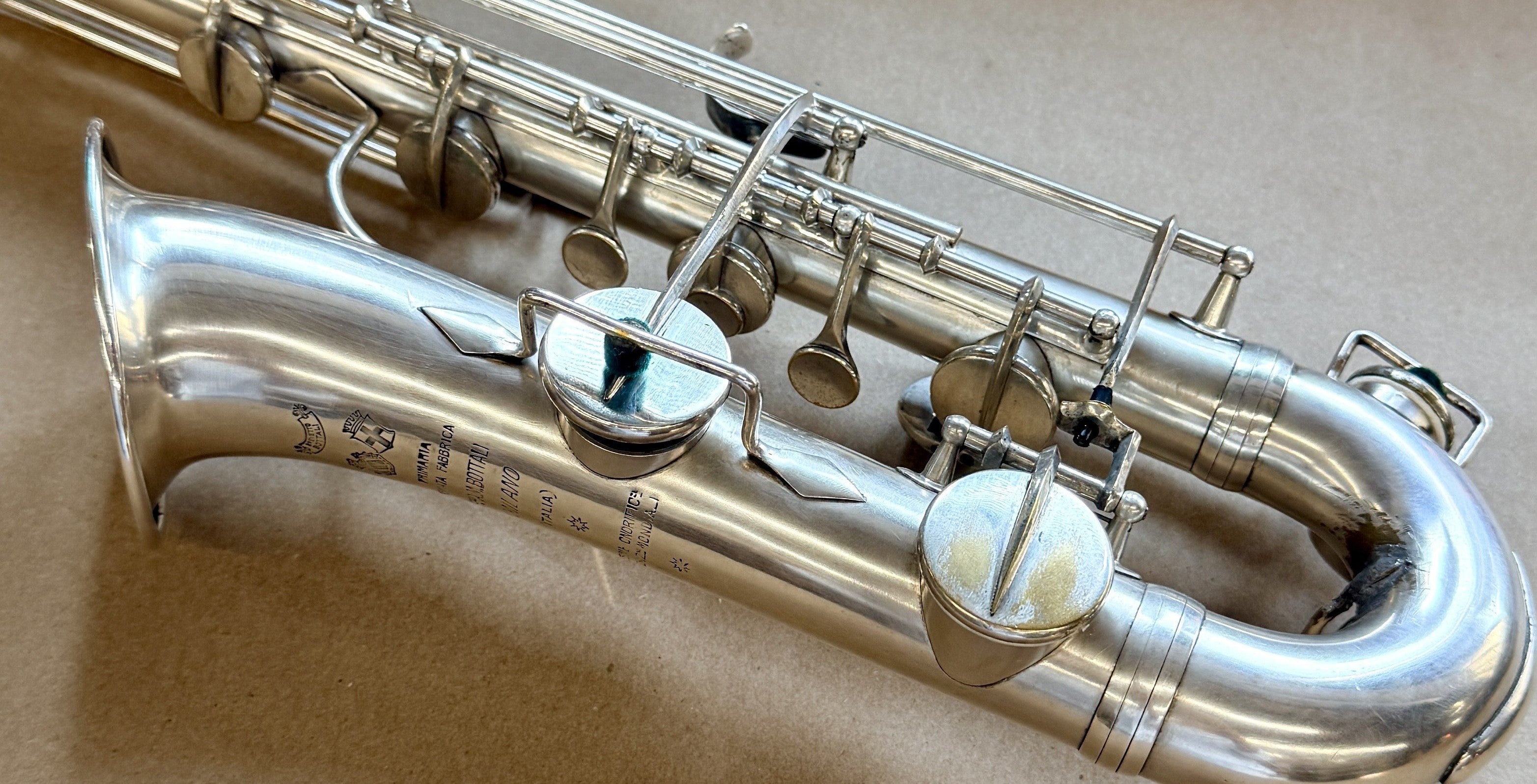
Which brings us to one instrument in particular: serial number AS189, in the highly unusual key of G.
Even among Sax’s already rare small ophicleides, AS189 stands apart. The key of G is unusual enough to stop even experienced players and historians for a moment. It does not fit neatly into the standard expectations modern musicians bring to brass families. That is part of its charm, but also part of its value. An instrument like this forces us to ask practical historical questions. What repertoire or ensemble use was imagined for it? What local or institutional preference might it reflect? Was it intended for a specific player, a particular band tradition, or a more experimental corner of Sax’s production? In the nineteenth century, not every instrument family was standardized in the way later industrial logic would prefer. There was still room for special cases, local demands, and designs that now seem startlingly individual.
AS189 is important not just because it is rare, but because it survives in a condition of unusual historical immediacy. It is, so far as is known, the only one of Adolphe Sax’s small ophicleides that is not currently in a museum. That fact matters. Museums preserve instruments, and we are fortunate they do. But an instrument outside museum walls occupies a slightly different place in the historical imagination. It can be studied in another way, handled in another way, and, one hopes, understood not only as an artifact but as a musical tool made for breath, fingers, embouchure, resistance, and sound.
There is something quietly moving about that. Nineteenth-century makers built instruments to be used. However elegant the engraving, however refined the craftsmanship, the final test was always musical life. Could it speak? Could it project? Could it blend or stand out as needed? Could a player trust it in performance? When a rare survivor like AS189 remains outside an institutional collection, it preserves at least the possibility of reconnecting those questions to the object itself. It reminds us that instrument history is not only about what we can display, but about what we can still learn through contact with the thing as a thing.
For players today, that matters more than it may first appear. The modern early-music and historical-performance worlds have already taught audiences to hear old instruments not as defective versions of modern ones, but as voices with their own logic and beauty. The ophicleide has benefited from that shift. Once dismissed as an awkward precursor to the tuba, it is now increasingly appreciated for its distinctive attack, grain, and flexibility. A small Sax ophicleide in G extends that conversation. It suggests repertories and colors we have barely begun to recover. It invites performers to think not only about reconstruction, but about the broader ecosystem of nineteenth-century sound.
Listeners, too, have something to gain from this perspective. We often imagine musical history as if great works were written for stable, familiar instruments that simply happened to exist. In reality, composers, players, and makers were constantly negotiating change. Instruments evolved under their hands. New mechanisms altered what could be played and what could be heard. An unusual instrument such as AS189 is a reminder that the nineteenth century sounded less fixed than our textbooks suggest. It was an era of experimentation, argument, and invention. Some of its most revealing stories survive in the objects that do not fit the neatest narrative.
Adolphe Sax understood that music history is shaped not only by masterpieces, but by infrastructure: by workshops, patents, repairs, contracts, military reforms, and the stubborn practicalities of design. He was a visionary, certainly, but he was also an engineer of musical life. His soprano and alto ophicleides show him working in that practical, searching mode, trying to refine and extend an instrument family at a moment when its future was uncertain. AS189, in the unusual key of G, carries that moment forward with exceptional clarity.
It matters because it is rare. It matters because it is beautiful in its improbability. And it matters because, for modern musicians, it opens a window onto a time when instrumental history had not yet settled into its current order. To encounter AS189 is to be reminded that the past was full of options, many of them ingenious, some of them fragile, and a few of them lucky enough to survive.
That survival places a quiet responsibility on us. Instruments like this deserve more than admiration from a distance. They deserve careful study, informed playing, and the kind of historical curiosity that treats craftsmanship as a form of thought. Sax built instruments to solve problems and expand possibilities. His small ophicleides, and especially AS189, show that even his lesser-known work was guided by that same ambition. For anyone interested in brass history, nineteenth-century innovation, or the endlessly inventive relationship between musicians and their tools, this is not a footnote. It is a vivid and very human chapter in the story.
The Unboxing.
Test Play!
Share:
A Practical Guide to Shires Q-Series Tenor Trombones
The Eastman CC Tuba Guide: Finding Your Sound in the EBC Series